Jefferson Nickel Series, Business Strikes
Overview of the Series
The Jefferson "Nickel" (5¢ ... there's no line in US Law that refers to a "nickel" as an actual denomination) was the fourth major series of US non-half-dime 5¢ coins, the second to be designed in the 20th century. It was first coined in 1938, which overlapped with the last year of the highly popular "buffalo" nickel. The coin was designed by Felix Schlag.
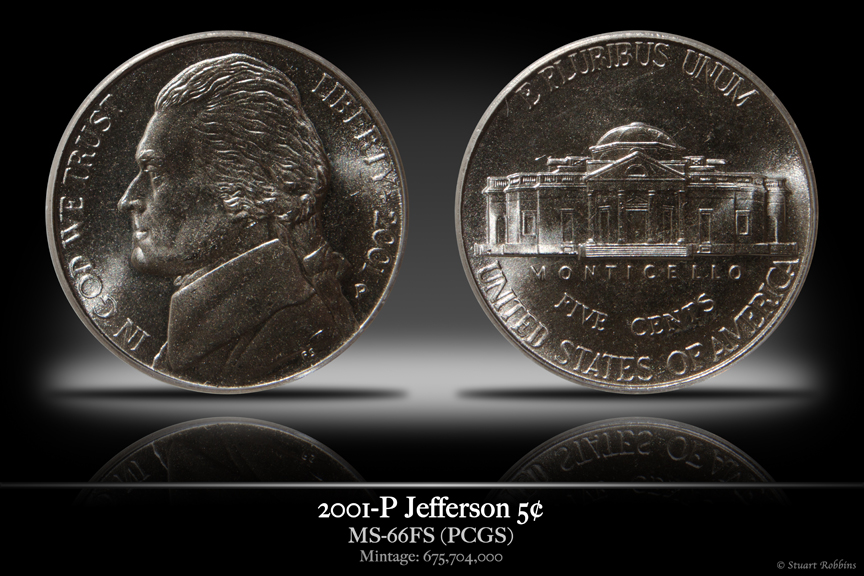
Through 2004, the coin featured Thomas Jefferson in profile on the obverse. Through 2003, it featured his home in Virginia, Monticello, on the reverse, which returned in 2006.
In 2004, the US Mint began a short, two-year "Westward Journey" series to commemorate the 200th anniversary of Thomas Jefferson's Louisianna Purchase from France, and the exploration of that territory by Lewis and Clark. There were two reverse designs both in 2004 (a replica of the Jefferson Peace Medal that was presented to local Native American chieftains, and a keelboat that the explorers used) and 2005 (an American bison, and the West Coast of the US in Oregon with a line taken from one of the explorer's journals). Also in 2005, the obverse was changed to a more modern design of Jefferson with his face still in profile, but taking up more space on the coin. "Liberty" was also written in Jefferson's hand as opposed to a standard typeface.
Rumors had circulated that the Mint was going to use this opportunity change the design of the nickel for a new series (stagnant, not rotating design) in 2006. Unfortunately for coin collectors, the congressional delegation from Virginia - which thinks that the state gets tourism due to the free advertising of Monticello on the reverse of every nickel - objected.
Congressman Eric Cantor (R-Virginia), the Chief Deputy Majority Whip for his party, was concerned that Monticello would not return to the reverse of the nickel in 2006. Some raised the issue that the Mint's proposed new reverse did not relate specifically enough to Lewis and Clark or the Louisiana Purchase, the events that the proposed changes were meant to commemorate. This led to the enactment of Public Law 108-15, the "American 5-cent Coin Design Continuity Act," in 2003. This act, originally dubbed the "Keep Monticello on the Nickel Act" by Cantor (gee, I wonder why they changed that name?), modified the United States Code to require the return to a depiction of Monticello starting in January 2006, and permanently eliminate the Mint's right to change it again without Congressional approval.
Definitely a sad day for coin collectors.
Coins in the Set
There are many coins in this set. If you just count business-strike coins that were made for circulation that are not mint errors, there are well over 100 different date/mint combinations to collect. This includes the coins from the first year of issue, 1938, through the war-time silver-nickel-manganese alloy in '42-'45, through the minor re-designs in the 1960s to the "Westward Journey" series of 4 coins in 2004 and 2005 that saw a revised obverse in 2005, to the new obverse in 2006 and its "Return to Monticello" of that same year.
Things to Watch in This Series
Color: Even though these coins are not silver (excluding the silver ones from 1942-1945), the older dates will frequently turn a fairly ugly yellowish shade. Thus, finding "untoned" examples can be difficult and will often command a higher price.
Strike: The strike on these coins is usually fairly good with detial in Jefferson's hair just generally soft to begin with. This is actually a series where strike will significantly affect the reverse - Monticello - and you should pay attention to the columns in the building as well as the triangle at the top. These will frequently appear soft and indistinct on poorer struk examples.
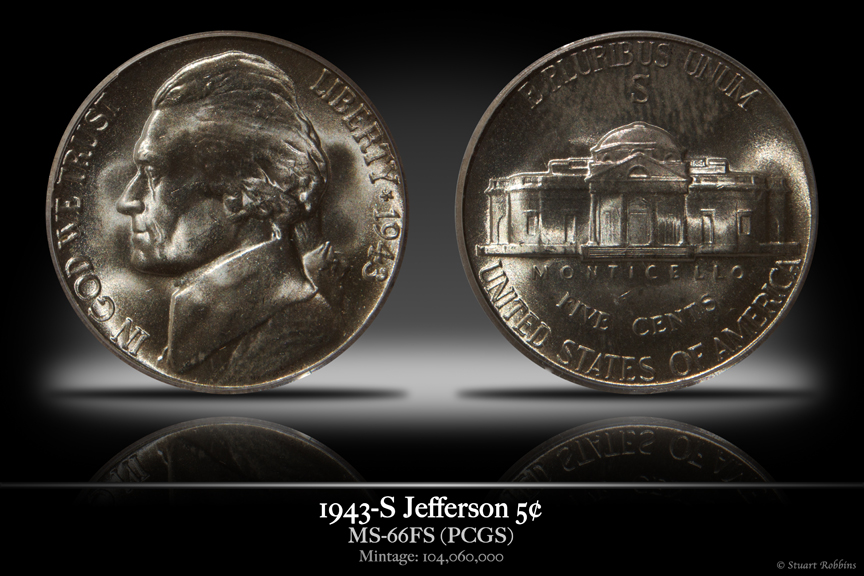
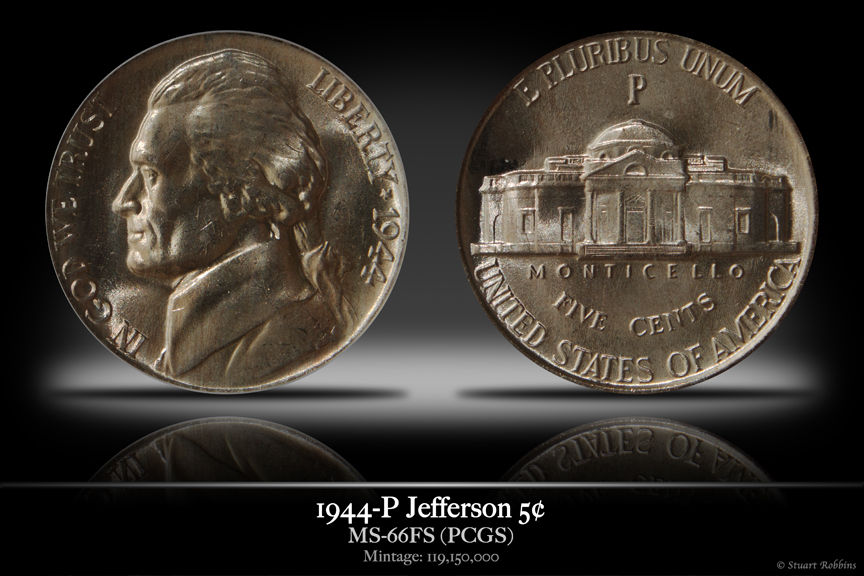
Strike - "Full Steps:" In fact, most grading services will help distinguish good from poor strikes by appending an "FS" or "Full Steps" designation to coins where the bottom steps in the center of Monticello are fully separated and distinct. Actually, this is the only case I know of where they will even designate different degrees of the "Full Steps" designation where some will grade with "6 Steps" or "5 Steps."
My Collecting Goal
This is a series where I really have not defined my collecting goal. Originally, it started out with a desire to get a complete set of MS-66FS war-time nickels, which is 11 coins. That is still my primary goal.
However, I've expanded it somewhat to include many of the early years in the series, with the rough cut-off of 1964 since that was the last year for the mint mark to appear on the reverse (next to Monticello on the right) before it moved to the obverse near the date. The goal is still to collect only MS-66FS at the moment, though this necessarily excludes many of the coins for me. For example, the 1939 S coin in MS-66 runs around $80 at auction. That same coin in MS-66FS brings in around $1,700. To me, it is just not worth spending that kind of money on a 5¢ coin at the moment.
Throughout the middle years (~1950s through 1980s), the coins were not sharply struck and so the FS coins command a huge premium (1964 MS-66FS brought about $2,000 at auction in 2010). Hence, I am avoiding them. I'm really, for the moment, taking much more of a, "What can I buy that's in MS-66FS that's reasonably priced that's not younger than I am."
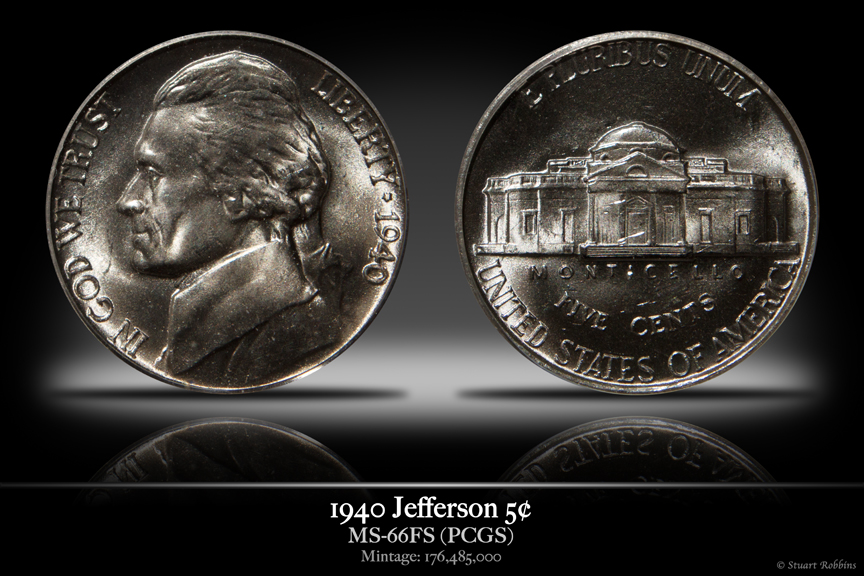
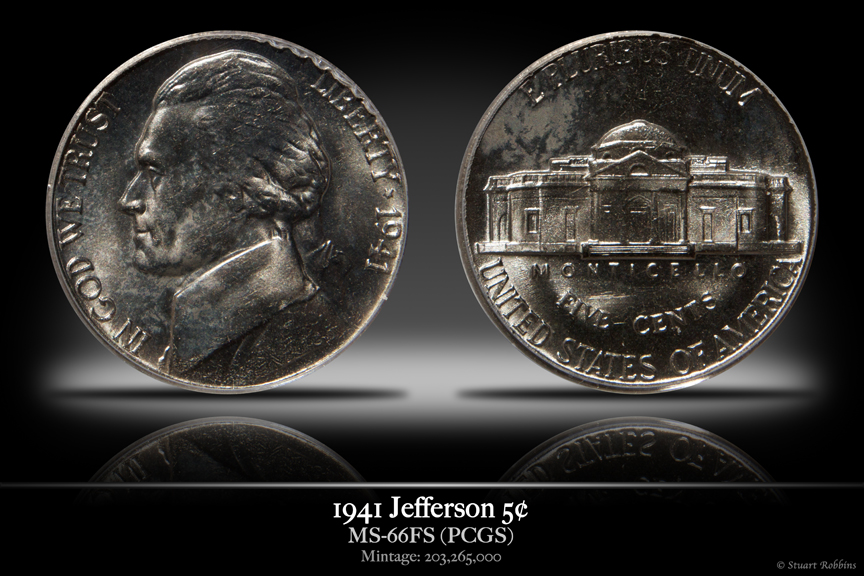
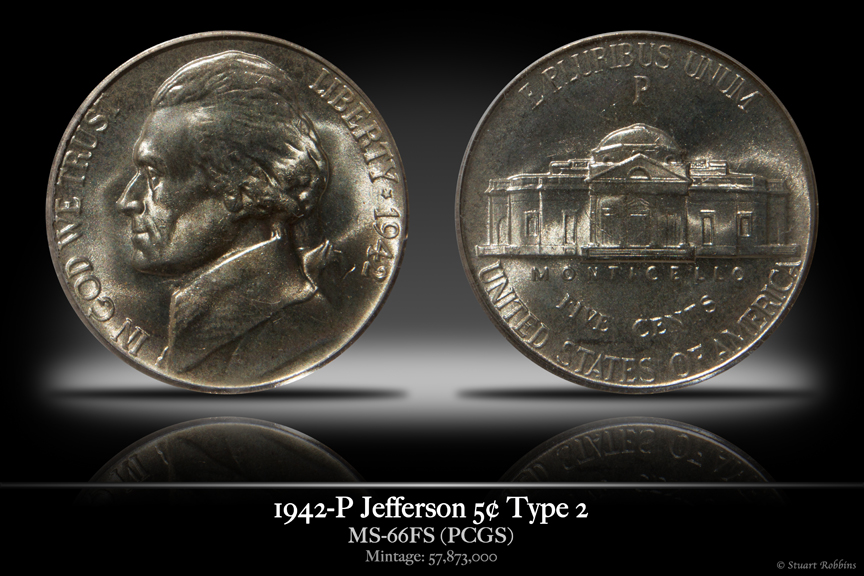
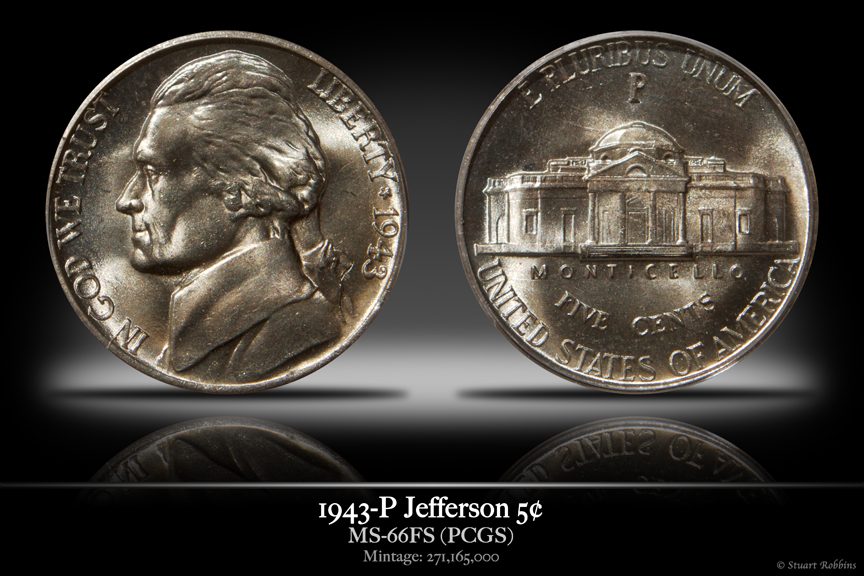
A Note on the Photographs: Because I'm collecting these in PCGS slabs, it is very difficult to take good photos of the coins because (1) I'm photographing through thick plastic, and (2) that plastic is scratched and has dust that accumulates no matter how many times I wipe it off. So keep in mind that the actual coins look better than the photographs make them out to be.



Checklist
| DATE | HAVE? | GRADE |
| 1938 | YES | MS-66FS |
| 1938 D | ||
| 1938 S | ||
| 1939 | ||
| 1939 D | ||
| 1939 S | ||
| 1940 | YES | MS-66FS |
| 1940 D | ||
| 1940 S | ||
| 1941 | YES | MS-66FS |
| 1941 D | YES | MS-66FS |
| 1941 S | ||
| 1942 | ||
| 1942 P | YES | MS-66FS |
| 1942 D | ||
| 1942 S | ||
| 1943 P | YES | MS-66FS |
| 1943 D | YES | MS-66FS |
| 1943 S | YES | MS-66FS |
| 1944 P | YES | MS-66FS |
| 1944 D | ||
| 1944 S | ||
| 1945 | ||
| 1945 D | ||
| 1945 S | ||
| 1946 | ||
| 1946 D | ||
| 1946 S | YES | MS-66 |
| 1947 | ||
| 1947 D | ||
| 1947 S | ||
| 1948 | ||
| 1948 D | ||
| 1948 S | ||
| 1949 | ||
| 1949 D | ||
| 1950 | YES | MS-66 |
| 1950 D | YES | MS-66 |
| 1950 S | ||
| 1951 | ||
| 1951 D | ||
| 1951 S | ||
| 1952 | ||
| 1952 D | ||
| 1952 S | ||
| 1953 | ||
| 1953 D | ||
| 1953 S | ||
| 1954 | ||
| 1954 D | ||
| 1954 S | ||
| 1955 | ||
| 1955 D | ||
| 1956 | ||
| 1956 D | ||
| 1957 | ||
| 1957 D | ||
| 1958 | ||
| 1958 D | ||
| 1959 | YES | MS-66 |
| 1959 D | ||
| 1960 | ||
| 1960 D | ||
| 1961 | ||
| 1961 D | ||
| 1962 | ||
| 1962 D | ||
| 1963 | ||
| 1963 D | ||
| 1964 | ||
| 1964 D |